
.png)
The Short Answer: Machine learning has changed how search engines interpret a search query, understand user intent, and surface relevant online content. For businesses, the response is not to chase algorithms but to build an SEO strategy around useful, accurate content, clean site structure, and a better user experience.
Machine learning is a branch of artificial intelligence that allows computer systems to learn patterns from training data and improve predictions without receiving explicit instructions for every situation. In search engine optimization, machine learning helps Google process natural language, connect concepts, identify spam, and return search results that better match what a user means.
What Is Machine Learning in SEO?
Machine learning uses algorithms, statistical models, and large data sets to recognize patterns and make informed predictions. These systems are common in computer engineering and artificial intelligence research, but their marketing impact is easy to understand: they help platforms process more information and respond more accurately.
For search engine optimization, machine learning influences how a search engine interprets a search query and evaluates which pages may provide the best answer. Google does not rank content based on a single signal or a fixed keyword formula. Its search systems evaluate many signals to find relevant, helpful, and high-quality content for a target audience.
Google explains that RankBrain helps it understand how words relate to concepts, while BERT helps it understand how combinations of words express meaning and intent. That means a page can appear in search engine results even when it does not repeat every exact phrase used in a search query.
How Search Engines Use Machine Learning
Machine learning supports several parts of the search experience. It can help a search engine identify duplicate pages, filter spam, interpret ambiguous language, understand image content, and personalize search results based on context.
Understanding User Intent
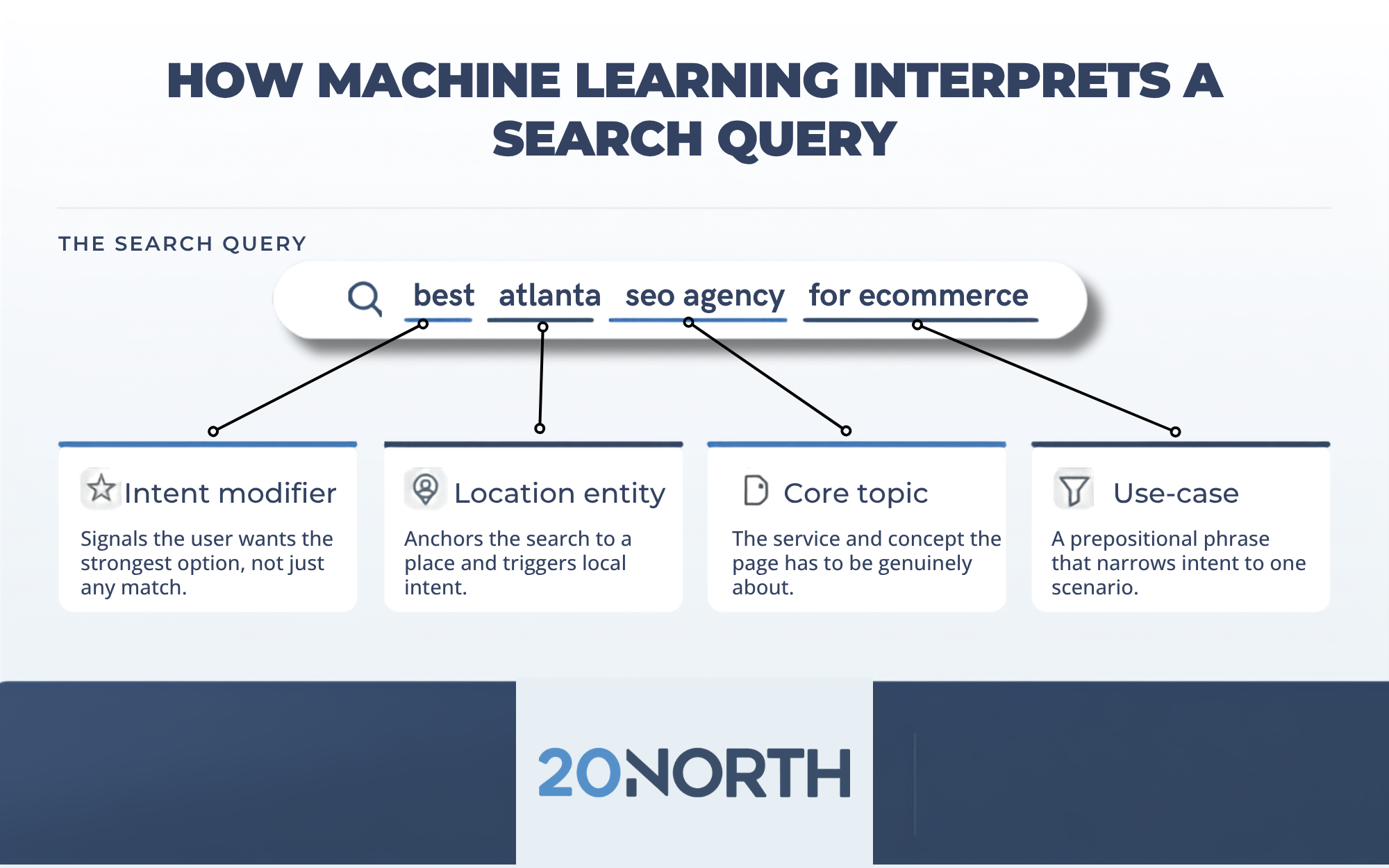
Machine learning helps Google interpret the natural language behind each query so the search engine can match results to likely user intent. For example, someone searching “best Atlanta SEO agency for ecommerce” may want a service provider, while a user searching “what is technical SEO” likely wants an educational explanation. ,This is why keyword research still matters, but keyword placement alone is not enough. SEO professionals need to understand what a user expects to find, what questions they need answered, and what content format best serves that need.
20North uses keyword research to uncover the phrases, topics, and search behavior that matter to your business’ audience. Our research drives content creation, on-page optimization, and broader content decisions.
Processing Natural Language
Natural language processing allows machines to evaluate the relationships between words in a sentence, including context and prepositional phrase usage. This matters because the language in two queries can share every keyword and still mean different things. Consider the difference between "boots for hiking in snow" and "snow boots for hiking." The words are nearly identical, but the product category, the use case, and the results a shopper expects are all different. Search systems use artificial intelligence and machine learning to interpret those distinctions more effectively.
Google’s BERT update marked a major step in natural language processing. BERT, short for Bidirectional Encoder Representations from Transformers, helps Google understand how word combinations affect meaning in a search query. Google’s documentation confirms that BERT supports its understanding of language and intent.
Identifying Quality and Relevance
Machine learning also helps search engines recognize patterns associated with low-quality content, duplicate content, and spam. It can compare pages at scale and identify signals that may indicate a poor content experience. That does not mean a machine can replace editorial judgment. A content editor still needs to verify facts, organize ideas, add subject matter expertise, and make content useful for the user. AI tools can speed up research, outline development, and content creation, but they do not automatically create content that deserves a higher ranking. Google advises publishers to create helpful, reliable, people-first content that serves an intended audience and leaves readers with a satisfying experience. Google’s people-first content guidance aligns closely with a strong SEO strategy, calling for original insights, clear answers to the user's question, and a reason to trust the page..
RankBrain and Modern SEO Strategy
RankBrain is one of Google’s artificial intelligence systems. It helps Google understand how words relate to concepts, allowing the search engine to return relevant search results even if a page does not contain every exact keyword used by a searcher. Google’s ranking systems guide describes RankBrain as a system that supports this type of concept matching.
SEO professionals should build a page around the topic, the questions behind the search query, and the information a user needs before taking action, rather than a single isolated keyword. Those related ideas help create a page that is more complete and useful than content built around repetitive keyword use.
What RankBrain Means for Content
- Write for user intent, not just keyword density
- Use clear headings that answer related questions
- Include natural language that reflects how people search
- Add examples, definitions, and supporting context
- Improve internal linking so users and search engines can discover related pages
- Prioritize high-quality content over thin online content
Machine Learning and Content Optimization
Machine learning can help marketers identify trending topics, analyze content gaps, group related keywords, and better understand the language used by a target audience. A bubble chart, topic cluster, or search query report can reveal where users need more information and where a business has an opportunity to improve its online presence.
Data should guide decisions rather than dictate every sentence. The best content creation process combines search data with real expertise, brand knowledge, and a clear understanding of the user.
Use AI tools to support your process:
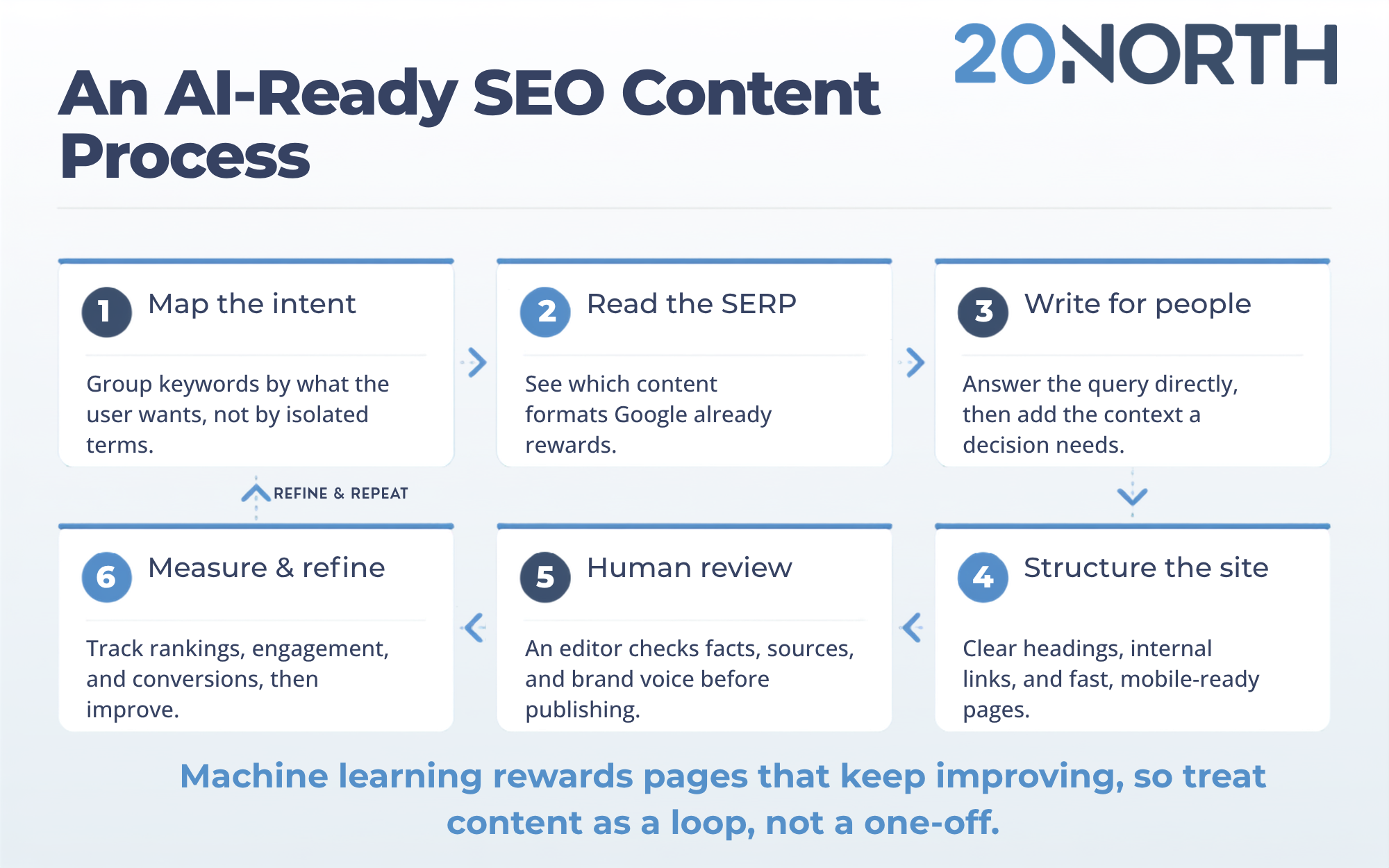
- Review search results to see the content formats Google already surfaces
- Group keyword research by user intent rather than by isolated terms
- Identify questions your audience asks before, during, and after a purchase
- Improve existing content with clearer explanations, stronger internal links, and updated examples
- Use a content editor to check accuracy, readability, and brand voice before publishing
- Monitor search engine rankings, engagement, and conversions after updates
A page earns value when it helps users accomplish something. That might mean learning a concept, comparing options, requesting a quote, or finding the right product. High-quality content should meet the right need at the right time.
Machine Learning in Google Ads
Machine learning also affects paid search campaigns. Google Ads uses Smart Bidding to optimize bids during each auction based on signals that may include device, location, language, browser, operating system, time of day, and other contextual factors. Google Ads explains Smart Bidding as a machine learning-based bidding process that optimizes for conversion goals at auction time. Responsive search ads use similar principles. Advertisers provide headline and description options, and Google tests combinations to identify ads that may perform better for particular searches.
For growing businesses, SEO and paid advertising work best together. Organic search can build long-term visibility around high-intent topics, while paid media can capture demand quickly, test messaging, and support time-sensitive campaigns.
How to Prepare Your SEO for AI
AI-driven search does not eliminate the need for search engine optimization. It raises the standard for content quality, technical performance, and user experience. Focus your SEO strategy on these priorities:
Build Content Around People
Start with the problem your target audience is trying to solve. Create pages that answer the search query directly, then add the context a user needs to make a decision. Avoid publishing content that exists only to repeat a keyword or fill a calendar.
Strengthen Your Site Structure
Search engines need to crawl, understand, and organize your website. Improve navigation, internal linking, page speed, mobile usability, and technical SEO so each important page has a clear role in the site’s data structure. A well-built website also supports stronger conversions after users arrive. Pair your SEO work with web development and conversion rate optimization to make traffic more valuable.
Keep Human Review in the Process
AI tools can summarize a previous study, organize a content brief, suggest related topics, or help an editor identify patterns, but they should not replace subject matter review, source checking, or thoughtful brand communication. For content that includes technical details, legal claims, healthcare information, or financial guidance, editorial review matters even more. Accuracy, original insight, and transparency create a stronger content experience for users and a more trustworthy online presence for your business.
Partner With 20North for AI SEO
Machine learning will continue to influence how Google understands content and delivers search results. Businesses that focus on user intent, helpful content, technical health, and measurable performance are better prepared to compete as search evolves. 20North is a full-servce digital marketing agency that combines search and AI engine optimization, paid advertising, email marketing, and web development to help growing businesses attract qualified traffic and turn it into leads.
Get started with 20North today to improve your company’s AI SEO visibility!
.png)
.png)
.png)