
.png)
The Short Answer: Marketing a multi-location business starts with dedicated location pages, one for each store, built with local SEO and specific to that market. Verify and optimize a Google Business Profile for every location so they rank in the Map Pack, then build reviews and run location-specific ads to fill the gaps while rankings grow. Keep branding, voice, and contact information consistent across all locations, and track rankings, calls, and foot traffic per location to see what's working.
Running one storefront is hard enough. Marketing a multi-location business means doing it several times over, keeping every business location visible in its own local market while the brand stays recognizable across all of them. A multi-location marketing strategy pulls together local SEO, Google Business Profile, online reviews, paid advertising, and social media so each individual location earns attention without watering down the brand.
Single vs. Multi-Location: Why Multi-Location Marketing is Different
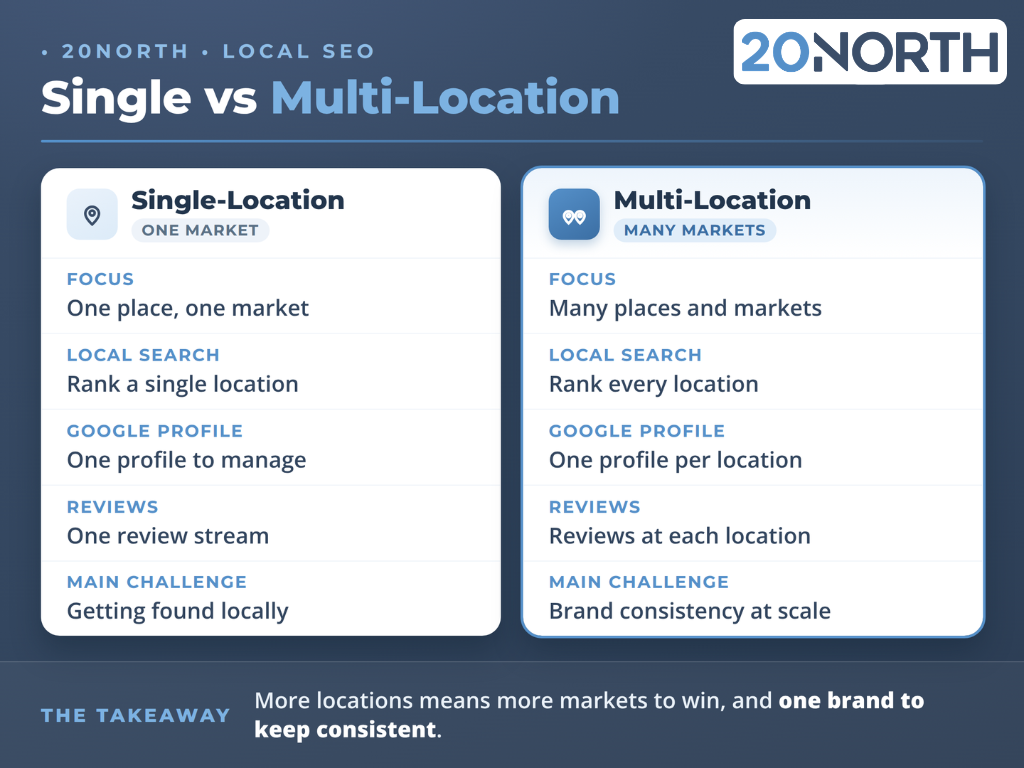
Single-location marketing aims to put your online presence in one place. Multi-location marketing has to do two jobs at once: rank each business location in its own local search results while holding brand consistency across the whole company, creating a real challenge.
A shopper searching in one city should find the nearest location with accurate contact information, while your brand identity, brand voice, and marketing materials look the same everywhere. Local teams often want independence, and a good marketing plan gives them room to serve their local audience while central marketing protects the brand.
Build Location Pages That Rank in Local Search
Organic traffic tends to convert well because those potential customers arrive with purchase intent, but it is also competitive and slow to earn. Organic search splits into branded traffic, people searching your company name, and unbranded traffic, people searching for the product or problem they need you to solve. Unbranded is harder to win but more valuable.
The way a multi-location business captures those searches is with dedicated location pages, sometimes called micro-sites: a separate page for each location, built with proper search engine optimization. These pages tell Google you have a genuine presence in different locations and lift your unbranded rankings. Building them is the first step, and many multi-location brands skip it. Keep each page specific, with the local address, hours, services, and content written for that local market instead of a copy-paste of your homepage.
Strong on-page optimization and clean web development make these landing pages easy for both shoppers and search engines to read. Our guide on how to reap the benefits of local SEO covers the page structure in more detail.
Advertise Every Location the Right Way
Organic rankings and Map Pack placement take time, so paid advertising fills the gap. A few formats matter most when you run different locations:
- Google Ads. When a potential customer searches a term tied to your products, services, or a competitor's name, your business should show up. This works well for a new location where the local audience does not know you yet.
- Map Pack ads. Similar to search ads, these push you to the top of the local map for chosen keywords. Keep a solid review profile before you run them.
- Retargeting. Location-specific, branded ads that re-engage visitors who landed on your location pages. Retargeting keeps your brand top of mind and gives shoppers a reason to return if a competitor lets them down.
Run location-specific creative so the message fits the market, and point every click to the matching location page. Our paid media and Google Ads teams at 20North build and manage these campaigns.
Own the Map Pack with Google Business Profile
When someone runs a local search, the map with three business listings at the top is the Map Pack. It often sits above the regular organic results, and sometimes above Google Ads, which makes it one of the highest-value spots for any local business. The Map Pack pulls from Google Business Profile, the tool formerly called Google My Business.
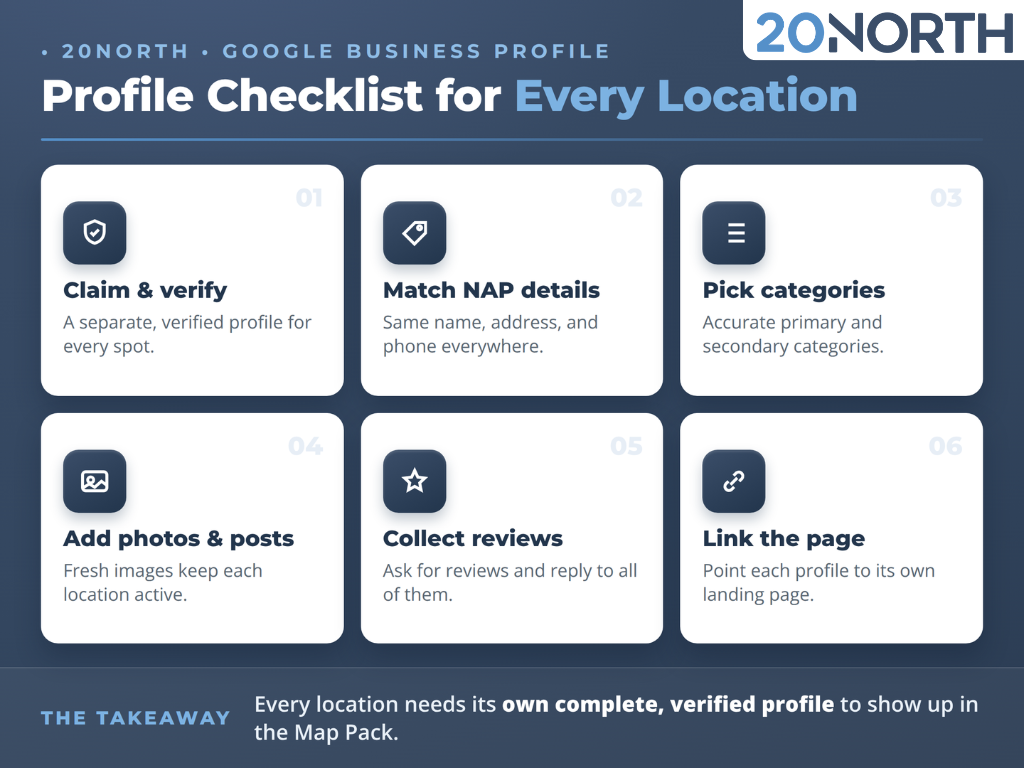
Step one is a verified profile at every specific location, each with consistent contact information, categories, hours, and photos. Then promote each profile through reviews, posts, and paid advertising. Matching the name, address, and phone across every location is what helps Google trust your listings and rank them, which drives foot traffic to the right door. Managing this across many profiles is the heart of local SEO. With every new location, it tends to get a little more difficult to manage, which is why the experts at 20North are here to help.
Turn Reviews into Local Trust
Reviews shape your Map Pack ranking and how potential clients judge you before they ever reach out or step foot in your business. About 96% of consumers read online reviews for local businesses, and only 4% never do, with Google the platform they check most. For a multi-location business, that means every individual location needs a steady flow of Google Business Profile reviews.
Ask happy customers to review the specific location they visited and respond to all of them. A calm, helpful reply to a negative review often matters more than the review itself, because future customers can see how you handle negative feedback. Set a simple process so local teams can request and answer reviews without waiting on central marketing.
Keep Branding Consistent Across Locations
Social media is where brand consistency gets tested. A multi-location business can run one master account for the whole brand or separate accounts per location, which is common in franchise marketing. Either way, keep the brand voice and visuals aligned so every specific location feels like the same company. Tools like Sprout Social make managing multiple accounts across different locations more workable.
Consistent branding reaches past social. The same logos, colors, and marketing materials belong on every location page, ad, and email. Local touches still help: posting about community events or a local market promotion makes an individual location feel present in its neighborhood while the national brand stays intact.
Tie it Together with Email and a Plan
Email marketing keeps past customers coming back to the location nearest them. Segment your list by business location so promotions, events, and hours reach the right local audience through email marketing built for each market.
Behind all of it sits one marketing plan that assigns who owns what: central marketing guards the brand and the tech, local teams handle reviews and community events, and everyone measures the same way. Track rankings, calls, direction requests, and foot traffic for each location so you can see which marketing solutions are working and where to invest next.
Grow Your Locations with 20North
Multi-location business marketing is a lot to manage, and there rarely seems to be enough time in the day for it. 20North is a full-service digital marketing agency that helps local businesses and multi-location brands grow their digital presence through search engine optimization, local SEO, paid media, email marketing, AEO, and web development. We help you build location pages, optimize every Google Business Profile, and keep your brand consistent across different locations.
Ready to grow? Contact our team for a free audit and a marketing plan built around your locations.
.png)
.png)
.png)