
.png)
The Short Answer: Keywords are the building blocks of search engine optimization. The right keyword strategy helps your website content appear when potential customers use Google search to find answers, products, or services. Short-tail vs. long-tail keywords is a useful starting point for better keyword research. Both types can support organic traffic and brand awareness, but they serve different roles in an SEO strategy.
The question is not simply which keyword has the highest search volume, but rather which search term best matches your target audience, their search intent, and the page you are creating.
What Are Short-Tail Keywords?
A short-tail keyword is a broad keyword, also called a head term or broad term. Short-tail keywords typically contain one or two words and cover a wide topic rather than a specific need.
Examples include:
- “Wallet”
- “SEO”
- “Digital marketing”
- “Roof repair”
- “Email marketing”
Because a short-tail keyword is broad, it often has higher search volume. It can also have high keyword difficulty because many businesses are creating content around the same keyword. A Google search for “wallet” could return product pages, articles, phone wallet results, payment apps, and related searches. Google has limited context about what the user wants, so the search engine returns a wide range of relevant results. Short-tail keywords can help a business build awareness around a category. A company that sells marketing services may want visibility for “digital marketing,” while a retailer may want to appear for a broad product category. Broad keywords are rarely the best starting point for a single blog post or service page. They often bring fewer qualified visitors because the user intent is unclear. Short-tail keywords can also produce lower conversion rates when the content does not closely match the reason behind the search query.
What Are Long-Tail Keywords?
A long-tail keyword is a more detailed keyword phrase, usually made up of three or more words. Long-tail keywords use specific phrases that reveal more about what a user is trying to find.
Examples include:
- “Best leather wallets for travel”
- “SEO agency for e-commerce brands”
- “How to improve local search rankings”
- “Roof repair financing in Atlanta”
- “Klaviyo email marketing agency”
A long-tail keyword usually has lower search volume and fewer searches than a broad keyword. That does not make it less valuable. The added detail gives the search engine a stronger signal about user intent, allowing it to return more relevant results. Someone searching for “best leather wallets for travel” is not looking for every possible type of wallet. They likely want a comparison, product recommendations, or a buying guide. A business that publishes a useful page matching that intent has a better chance of attracting qualified organic traffic. Long-tail terms often face lower competition than head terms, and they can drive a higher conversion rate because visitors arrive with a clearer goal. For growing businesses, that makes long-tail keywords a practical way to reach target niche audiences without competing only for the biggest, most difficult terms. A user searching for a web development company might begin by searching “website design.” It could then develop long-tail keywords such as “website design for construction companies” or “custom website development for e-commerce brands.”
Short-Tail vs Long-Tail Keywords
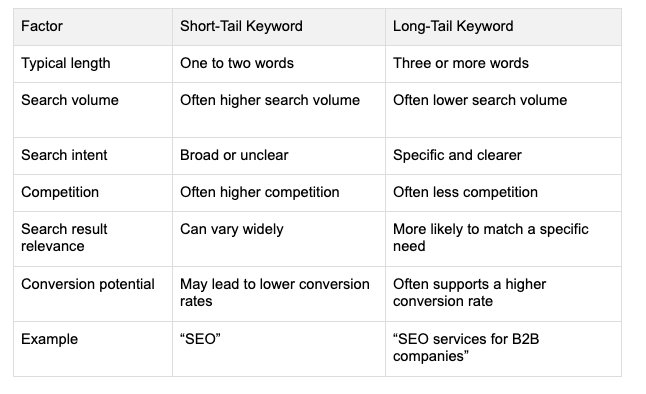
The best keyword strategy uses both. Short-tail terms help define core topic areas and build visibility. Long-tail keywords help you create useful pages that answer detailed questions, address pain points, and support stronger conversions. Here’s how the two keyword types compare when you're planning a strategy:
How Search Intent Shapes Keyword Choice
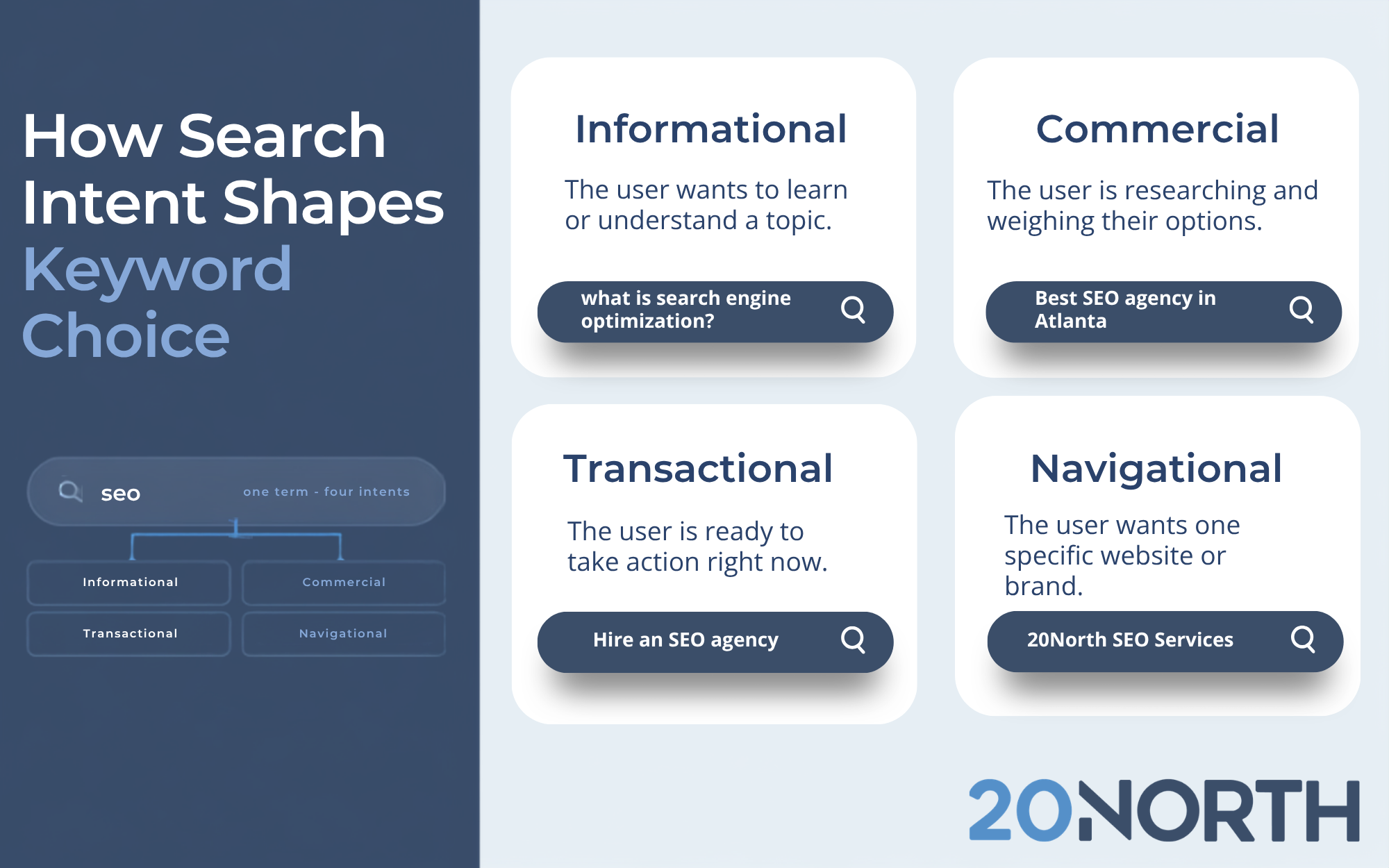
Search intent is the reason a person enters a search term. It is one of the most important factors in keyword research because a page must satisfy the user’s goal, not simply repeat a keyword.
Most search queries fall into a few common intent types:
- Informational: The user wants to learn, such as "What is search engine optimization.”
- Commercial: The user is researching options, such as “best SEO agency in Atlanta.”
- Transactional: The user is ready to act, such as “hire an SEO agency.”
- Navigational: The user wants a specific website or brand, such as “20North SEO services.”
A broad keyword may include several types of intent at once. A detailed keyword phrase usually narrows the possibilities. Before creating a blog post, product page, or service page, search the target term yourself and examine the search engine results. The pages that rank can show you the format Google believes best serves that search query.
The Best Resources for Keyword Research
Semrush
Semrush gives marketers a deeper view of keyword opportunities, search competition, and the pages already ranking in search engine results. Its keyword research tools are useful when you need more context than a single search volume estimate.
Start with a broad keyword or head term in Semrush’s Keyword Magic Tool. The platform can return related keywords, long-tail keyword ideas, question-based search terms, and keyword phrase variations that can support blog posts, service pages, and broader content creation. Semrush also groups related terms by topic, helping you identify themes that can become content clusters or internal links across your website
Google Search Suggestions
Begin typing a broad keyword into Google Search and review the autocomplete suggestions. These suggestions can reveal common keyword phrases and show how searchers refine a broad term.
Search the full phrase and inspect the related searches area at the bottom of the results page. These terms can uncover supporting topics for internal links, section headings, and future blog posts.
People Also Ask
The People Also Ask section is useful for identifying questions your target audience wants answered. Use those questions to guide blog post sections, but write the answer in your own voice and add practical context for your readers.
Google Keyword Planner
Google Keyword Planner can help identify search volume, related keywords, and ad competition data. It is part of Google Ads, formerly known as Google AdWords, and can help teams find keyword ideas for both paid advertising and SEO planning.
For SEO research, treat search volume as one data point. A keyword with fewer searches may be more useful than a term with higher search volume if it matches your product, audience, and conversion goal.
Google Search Console
Google Search Console shows the search queries already bringing people to your website. Review the queries associated with pages that receive impressions but have low click-through rates. Updating titles, headings, and on-page copy can help those pages better match the search result users expect.
Search Console can also expose related keyword opportunities that your website already has a chance to win. Pair this data with on-page optimization to improve relevance without creating unnecessary pages.
Match Keywords to Your Content
The right keyword is one that fits the page, the target audience, and the business goal. Do not force a keyword phrase into every paragraph, but instead, build the page around a useful answer, then use relevant keywords naturally in the title, headings, body copy, image alt text, and internal links.
For service pages, use terms that reflect what you offer. Internal links help users discover related website content and show search engines how your pages connect. Use descriptive anchor text that tells readers what they will find after clicking.
How to Choose the Right Keyword and Build a Strategy That Supports Growth
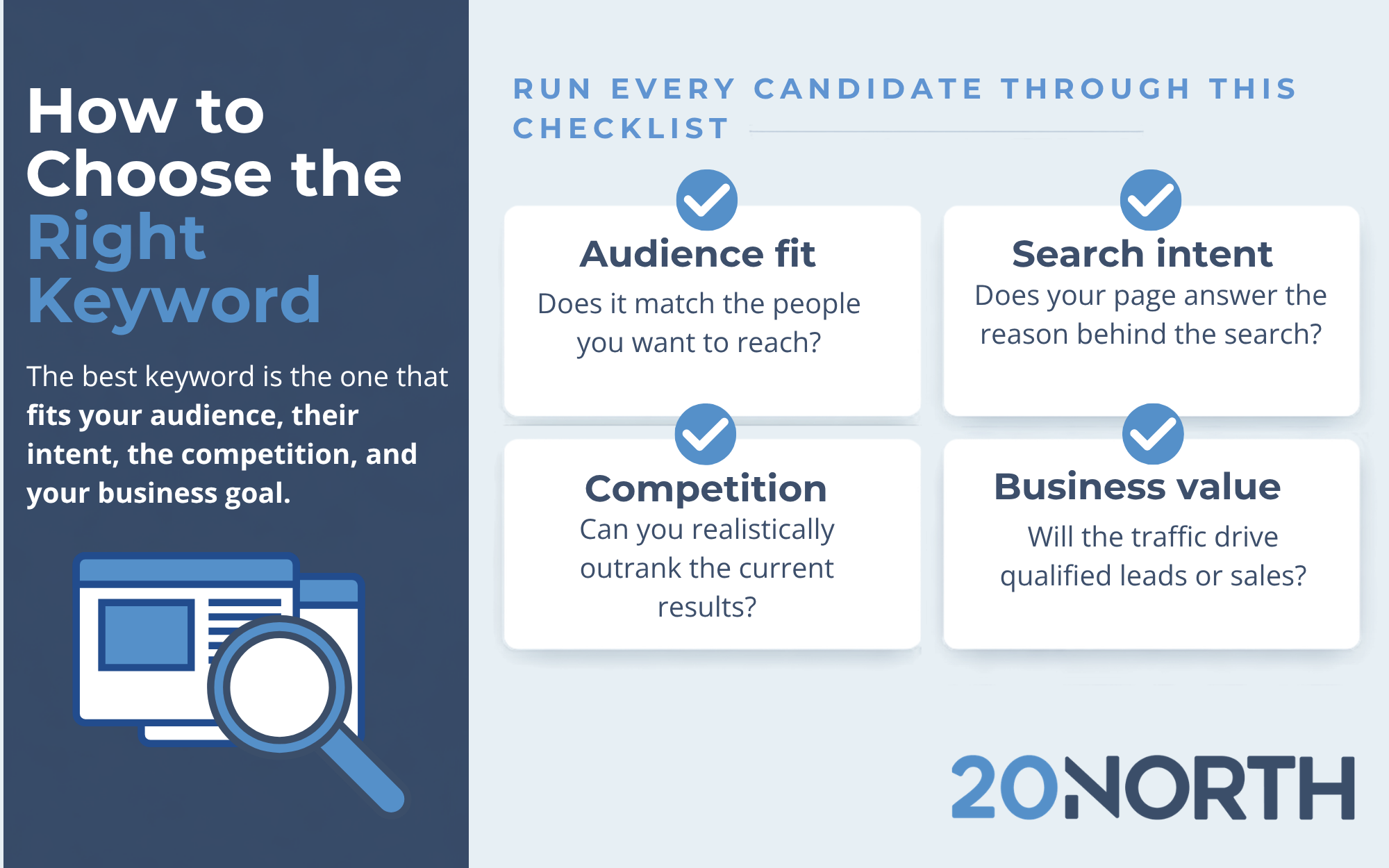
Good keyword research starts with understanding your unique selling proposition and the needs of your target audience. Ask what problems your product or service solves, what questions customers ask before buying, and what language they use when describing those problems.
Then prioritize keywords based on:
- Relevance to your business and audience
- Search intent and the type of page needed
- Search volume and realistic keyword difficulty
- The level of competition in search engine results
- Potential to drive qualified traffic and conversions
- Opportunities to create useful content and internal links
Short-tail keywords can define your larger topic clusters, while long-tail keywords can fill those clusters with focused, useful content creation that reaches people closer to a decision. The goal is not to rank for every keyword. It is to build a connected content library that helps the right people find useful information, understand your value, and take the next step.
Grow Your Organic Traffic With 20North
Short-tail and long-tail keywords work best when they support the same SEO strategy. Broad keywords can help define the larger topics your brand wants to own in search engine results, while specific keyword phrases can connect your website content with users who have a clearer need, question, or buying intent. The right balance depends on your target audience, the competition in your industry, your current website authority, and the pages already on your site.
20North helps growing businesses turn keyword research into a practical SEO strategy through search engine optimization, on-page optimization, content creation, technical SEO, and internal-link planning. Our Atlanta digital marketing team also connects SEO with paid advertising, email marketing, conversion rate optimization, and web development to help your business attract the right audience and turn more website visits into measurable growth.
Get in touch with 20North to discuss your SEO strategy.
.png)
.png)
.png)